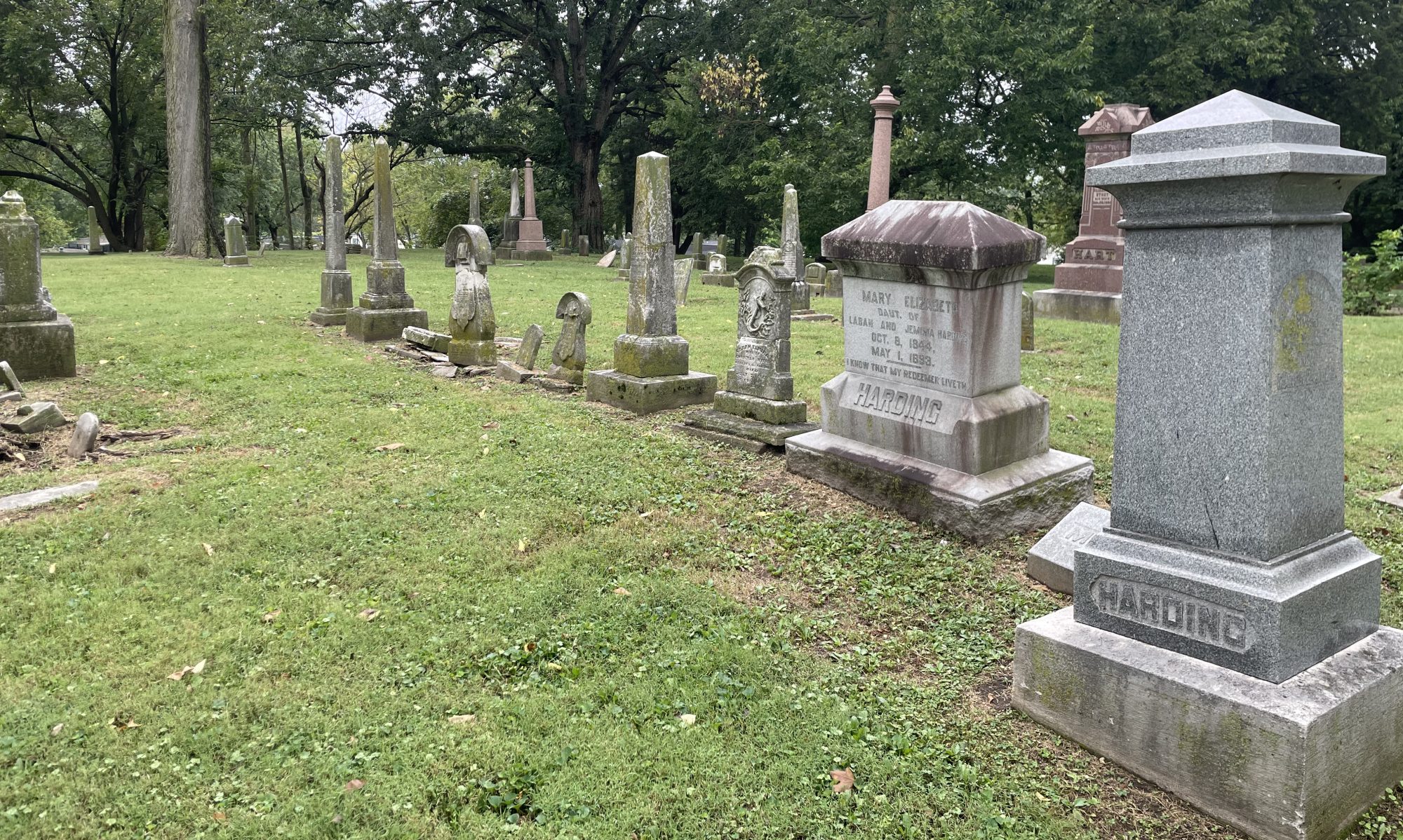
In the field of historic cemetery preservation, the guiding philosophy is absolute: do no harm. For decades, well-intentioned caretakers and volunteers made the mistake of using harsh mechanical scrubbing, pressure washers, or abrasive wire brushes on weathered stones, causing irreversible damage to fragile carvings, tool marks, and stone faces.
Today, professional conservators rely on passive, non-destructive cleaning techniques. While this method is invaluable for addressing stubborn atmospheric pollutant crusts, intermittent water misting can also be deployed for many different cleaning issues when a marker is simply too fragile to clean by hand.
1. Understanding Gypsum Crusts and Carbon Staining
Before exploring treatment methods, it is essential to understand what gypsum crusts are and how they form on historic monuments.


- The Chemical Reaction: Gypsum crusts develop primarily on calcium-rich stones like limestone and marble. When atmospheric sulfur dioxide ($\text{SO}_2$)—emitted from industrial burning, coal smoke, and urban pollution—interacts with moisture in the air, it forms sulfuric acid. This acid reacts chemically with the calcium carbonate {CaCO} in the stone, converting the outer mineral layer into gypsum {CaSO}.
- The Role of Carbon: As this fragile gypsum matrix forms on the surface, it acts as a sticky trap for airborne soot, dust, and carbon particulates. Over decades, this combination bakes and hardens into a dense, disfiguring black crust.
- The Structural Danger: Because gypsum occupies a larger volume than the original stone minerals it replaces, and because it traps moisture and pollutants beneath its hard exterior shell, it creates immense internal stress. When these chemical crusts interact with stones prone to structural vulnerabilities—classified as an inherent vice due to natural bedding planes, mineral banding, or internal weaknesses—the monument becomes highly susceptible to fracturing and surface loss.
2. What is Intermittent Water Misting?
Intermittent water misting is a controlled, low-pressure conservation technique designed to soften hardened surface crusts or surface soils without saturating the stone or exerting mechanical stress on fragile substrates. Rather than blasting a monument with a high-pressure hose or aggressively scrubbing with stiff bristles, a fine, atomized mist of water is applied to the stone periodically over an extended period.
This controlled hydration softens the dense buildup. By keeping the wetting intermittent, contaminants and crusts are allowed to gradually swell, loosen, and safely release their grip on the stone face through gentle softening phases and minimal rinsing—making it an ideal technique when a marker is too compromised for standard physical cleaning.
3. Why Aggressive Cleaning Fails Vulnerable Stones
Using high-pressure water or aggressive physical friction to remove carbon staining, biological films, or grime triggers immediate issues on fragile markers:
- Accelerated Delamination: High-pressure water forces its way into microscopic bedding planes beneath or around the crust, driving sheets of stone apart like pages in a book.
- Surface Erosion: Stiff bristles and metal scrapers scour away the soft outer skin of the stone beneath the staining, destroying subtle hand-chiseled lettering and tool marks forever.
- Aggravated Spalling: Hardened crusts act as a dense, impermeable shell that traps moisture underneath. When physical stress or aggressive scraping is applied to these tensioned surfaces, the outer face of the stone shears away completely.
4. The Science and Benefits of Misting for Delicate Markers
Intermittent misting works in harmony with the physical and chemical properties of the stone and surface accumulations:
- Controlled Hydration: By applying a fine, intermittent mist, moisture slowly penetrates surface layers or hardened matrices without flooding the stone’s interior pore network, preventing dangerous internal hydrostatic pressures.
- Safe Softening Without Scraping: Repeated cycles of misting allow water to migrate behind and through micro-fissures, softening stubborn bonds so contaminants can be eased away safely without abrasive friction. This passive approach provides a vital alternative whenever a marker is too fragile to withstand cleaning by hand.
- Preservation of the Stone Skin: By eliminating the need for physical scraping or harsh chemical stripping, the original tool patinas and historic surfaces remain completely undisturbed.
5. Best Practices for Implementing Misting Treatments
When planning a misting regimen for carbon-stained, gypsum-crusted, or exceptionally delicate markers, proper execution ensures optimal safety for the artifact:
- Assess the Stone First: Always evaluate the condition of the marker. If a stone is actively delaminating, severely spalling, or suffering from advanced structural breakdown, consult a professional conservator before introducing any moisture.
- Monitor Weather Conditions: Avoid misting or cleaning stones during freezing temperatures. Trapped moisture undergoing freeze-thaw cycles will generate internal pressure and cause spalling.
- Combine with Gentle Softening Tools: Allow the misted surface to soften over time. Follow up with low-pressure water rinses or very soft, natural-bristle horsehair brushes only when the buildup has fully surrendered its bond—and bypass brushing entirely if the stone remains too fragile.
- Maintain Detailed Records: Keep thorough logs of all cleaning protocols, exposure times, and dates of maintenance to track the long-term health and stability of the historic markers.
You must be logged in to post a comment.